There are many individuals recorded in our Western history that are very familiar to us all. W.F. Cody, Wild Bill Hickock, Kit Carson, George Armstrong Custer, Bat Masterson and Wyatt Erp are among the most famous. There are also less famous men who contribuited to the expansion of the Western froutier that are seldom mentioned in our literature. In fact, one of these men was responsible for outfitting a number of the above listed individuals. That man was John Prey Lower.
J.P. Lower, as he liked to be called, was born in 1833 to a Philadelphia druggest. At an early age, he developed a keen interest in firearms, and his father allowed hime to own a small caliber rifle for hunting in the "wild west" of Pennsylvania. His father made him a partner in his store at an early age, and during his walks to the shop, he often stopped to window shop at the store of G.C.Grubb, a local firearms dealer and gunsmith. On one of these occasions, Mr. Grubb invited the lad into the shop, allowing him to view and handle all the latest guns from Colt, Remington and Sharps. It wasn't long before he was spending more and more time at Grubbs, and neglecting his own shop.
His father was understanding, and when Grubb offered Lower an apprenticship when he was just 13, his father let him go to his first love. Within five years, he had become a master gunsmith, working on all the known guns of the day.
By 1858, Grubb expanded his business, sending Lower out on the road "drumming". He was the first gun salesman to cross the Mississippi, and traveled extensively throughout the US and even South America. Somehow avoiding the civil war drafts, he managed to travel throughout many of the war torn states during the first three years of the war.
In his capacity as traveling gun salesman, he came to know all the great gun manufactures of the day, including Sam Colt, Remington, Smith and Wesson, Christian Sharps and later on, Winchester. He considered these men his warm, personal friends, and claimed to have spent many a happy hour on their target ranges, testing the latest offerings. This relationship would be valuable when creating his own business in later years.
By 1868, the railroad had reached Larimar City, Wyoming, and Lower would take the train to the end of the line, proceeding from there by stagecoach, boat or wagon. In his own words, "Pretty rough traveling in those early days." It was on one of those trips that he met Carlos Gove, a gunsmith that worked out of Denver. Gove had been in Denver since 1865, and was well established in the area. The two men hit it off, and by 1872, Lower had left Grubb to open a shop with Gove in Denver.
In those early days, Denver supplied most of the hide hunters in the area, and business was brisk for those selling the new Sharps heavy barreled single shot rifles. The two partners concentrated on these sales, but Lower realized that the demand for other weapons and sporting supplies was growing amongst the townfolk, ranchers and miners. Gove didn't share the vision, and by 1875 Lower went out on his own, buying out the Fruend Bros. gun shop at 381 Blake street. He moved the contents to his first shop on Larimer street, but in a few months reclaimed the Blake street store. The city directory for 1875 lits Fruend Bros. at 381 Blake, while the directory for 1876 lists Lower's Sportsmans Depot at the same address. Now his past relationship with the great gun manufactures would earn him a small fortune.
His great shop was probably a lot like today's large sporting goods stores. He carried every recreational item of the day, including guns, ammunition, fishing gear and bait, camping supplies and foraging equipment. As his shop became more well known, indians began trading their personal possessions for arms and supplies. He amassed a huge collection of artifacts from the early Colorado frontier, that today would be worth a fortune.
It is a little known fact that J.P. Lower also owned a partnership with a George Wilson in a sandstone quarry at Fort Collins. With the gun shop and quarry, Lower was worth over $100,000 by 1885, a considerable sum in those days, equal to a million or more today. Most of the oldest building in Denver that still survive were built using stone from his Fort Collins Redstone Company.
In 1886, Lower's wife took ill, and within a year was near death. He took her back home to Philadelphia, where she died a few months later. Upon returning grief stricken to Denver, he was shocked to discover that his partner, Wilson, had bankrupted the business and absconded with all the funds! Detectives were sent in search of him, but by the time John tracked him down personally in Chicago, and brought him to task, the money was gone.
Lower had to borrow money to keep the gun store alive, for as the frontier settled down, demand for guns also went down. The quarry was taken over and sold to pay off the many bad debts Wilson had created, leaving Lower no choice but to continue to ply the gunsmith trade with his two sons, George and Clarence. By 1910, in his late seventies, he was still working, even though suffering from bouts of exhustion. He walked to work every day, and eventually was noted as one of the last remaining Colorado pioneers by the Denver Times newspaper. His 1910 interview with them supplied most of the information presented here. He presented himself to the reporter as a man of the world, who considered himself "husky" and "still able to tramp around with the younger men." (!) At that time, he was still trying to raise money by offering a great range of artifacts from the early days to the city and state, who seemed to have no interest in paying for any history. Many of these artifacts have been lost to the world forever.
His most prized artifacts were silver peace medals, given to Indian chiefs for various treaties over the years. He had a Washington medal, his most coveted, and a Lincoln medal that had a great story attached to it.
A Ute chief named Honko came to the store after a fight with some Arapahos. He was struck in the chest by a bullet which had hit the medal on the upper left quarter, deflecting the shot but knocking him cold. He slammed the medal on Lower's counter and stated "Bullet, him knock me dead. Squaws pour heaps and heaps of water on me. No dead after two hours. Bad medicine, no want, TRADE!"
After the usual haggling, Lower obtained the medal. The Washington medal was much harder to trade on, requiring two years of negotiations, its owner finally satisfied with the goods he had received. Where these two medals are today remains a mystery, but perhaps someone will one day find a dented Lincoln peace medal at a garage sale. I hope it has not been melted down for scrap! But getting back to the heyday of his business, guns and equipment were the hot items in the late 1870s.
According to the American Numismatic Society, it was donated by J. Sanford Saltus in 1917 and has resided in their collection ever since! It is currently on display in New York at the Federal Reserve Bank exhibit "Drachmas, Doubloons and Dollars" A complete story on this medal and it's disposition since 1913 will be featured in an up coming Coin World magazine.
Lower's business was good, and factory records from Colt and Sharps confirm hundreds of pistols and rifles shipped every month. He was receiving 50 guns at a time from Colt, and ordered special hunting rifles from Sharps for the prominent businessmen of the area. These guns could be priced at more than 200 dollars in the fancy, engraved versions, and Lower didn't hesitate to advertise these great rifles. He would place
them in his showcase or in the store windows, along with written testimonials from individuals who had used them.
In 1880, to promote the Sharps Borchardt rifle, he posed for a photograph holding one of them next to a 200 yard target atop a bear skin. The label used in various newspapers and on ammunition he sold stated "50 shots at 200 yards".
He was know as one of the best shots in Denver, and had a private range behind his store. When you check out the store photos below, you'll see the indoor target at the end of the shop! He claimed he could hit a dime thrown in the air repeatedly, but did not state what weapon was used for this feat. More than likely, it was a .22 Winchester pump. If it was a Colt, that's something I'd really liked to have seen!
Imagine walking into his store, with all the smells of cigar smoke, trade goods and animal pelts wafting in the air. Your boots clunk on the wooden floor as you walk to the counter, where John greets you with a smile. You inquire about a nice Colt Frontier Six Shooter in the case. He brings it out, and offers you a test fire in the back range. Soon the place is full of sulfurus smoke, and you decide to buy the Colt. You have to wait your turn though, several Indians are making a fuss over the size of a hide from a buffalo they killed. Lower seems interested in their claims, nodding and stroking his beard as the traders wave their hands around. The trade is made, and of for all things, a concertina. The Indians sit around the new owner as he makes horrendous screeching and wheezing sounds with the instrument. The others in the store howl with laughter. So do you and John, but the Indians just stare and watch the performance with awe. One of them pokes the bellows with his finger, recoiling quickly as the folds pinch it.
"Squeeze box, him good spirit" says the newley anointed musican, "Good for dance, scare away enemies!"
Collecting guns shipped to Lower has grown into a passion for many collectors, myself included. There are few antique guns that can be traced to a Western location through factory research. Colts records are complete concerning his shipments, listing not only single actions but 1878 double actions and the 1877 lightning pistols. Winchester records seldom list a shipping location, but many of the Winchesters he received were stamped with the logo "J.P. Lower, Denver, Col." You will find Sharps rifles with this stamp, and factory letters are available for them as well.
Lower had special shotguns made for him by an English firm that featured his logo on each side plate and on top of the barrel rib. It is great to locate any of these weapons, for holding one of them is holding a piece of our Western heritage. Who knows what individuals owned them and in what manner they were used? For better or for worse, they are truly one of the best examples of western history.
John P. Lower died on August 22, 1917, leaving this world in debt and without a healthy heir to continue the business. His son Clarance was crippled from a birth defect, and could do little but sell at the store. George had died a few years before, and it is said that the old man just didn't have it in him after that. He was one of the last great 19th century gunsmiths, having devoted most of his life to the trade. We must not ever forget these unsung heros of our great Western heritage. Collecting and appreciating guns shipped to his store is one way of preserving that heritage.
A BRIEF HISTORY OF COMPANY K, FOURTH CAVALRY.
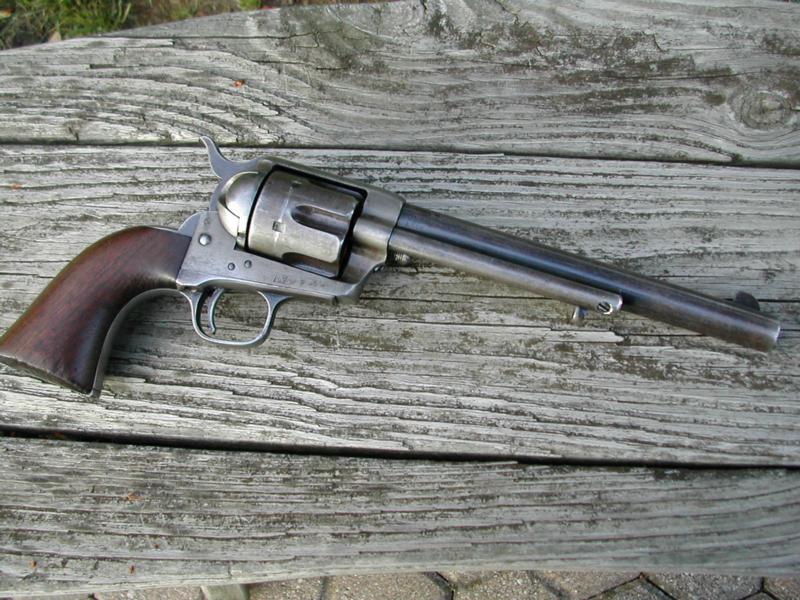
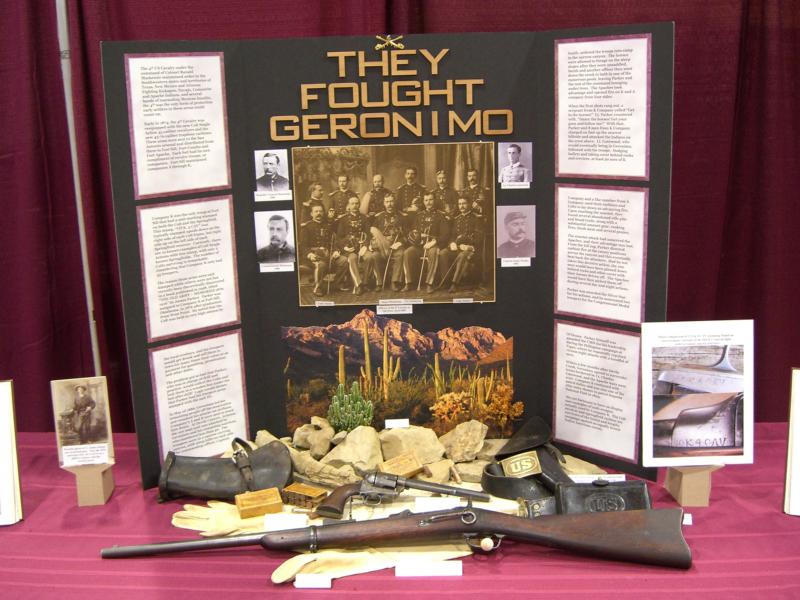
If you have seen the Company K Colt and Trapdoor carbine on the collections page, here's a little historical background. Company K was stationed at Fort Sill, Oklahoma. Having received the new Colts and Springfield carbines, issued from the San Antonio arsenal, they were responsible for keeping order among the Indians and settlers in the territory and surrounding states of Texas, New Mexico and Colorado.
K Company was commanded by a Captain Hyel, had 40 troopers, three officers, a civilian interpreter and possibly 4 to 6 Indian scouts. One of the officers, Lt. James Parker, was assigned to K Company in 1876 after graduation from West Point. Parker fit in well, and was a take charge officer from the start. In his book, "The Old Army", he wrote that the Colt cavalry revolver was held in high regard by the local settlers and cowboys, who would pay three to five times the value if they could convince a soldier to sell one. Parker said theft was rampant on the post, so in order to keep track of these valuable weapons, he would collect them after drill and lock them in a wooden box, which he kept under his bed! Logic would dictate that Parker was the officer responsible for the stamping of CO K 4 CAV on these Colts and carbines. No other cavalry company at Fort Sill has been represented with a similar stamping on any known weapons.
Parker and K Company marched into Mexico in May of 1878 to quell marauding Kickapoo and Apache Indians. Mexican soldiers had been trading with these killers of Texas citizens, and were prepared to fight the Americans. Ranald Mackenize, the regimental commander, claimed that there would be war with Mexico, but it was not to be. After a grueling march searching for the Indians, he returned to the border without encountering any hostiles. There, at the Rio Grande, he collected K and M company and proceeded towards Remolino. He had three units of light artillery with him, including several Gataling guns. The Mexicans and Indians were intimidated, and when confronted, rattled sabers and then fled the field and town. The Mexican government eventually cooperated with the U.S. and the menace was finally brought under control. John Wayne's "Rio Grande" was loosely based upon this story, and Charlton Heston's "Marjor Dundee" was even closer in context.
In 1880, Parker was given complete command of K company after Hyel was sent east for several years. He was especially happy and proud of this promotion to 1st Lt., and his troop, Company K, the Black Horse troop, became legendary in the Cavalry for their ability at drill and tactics..
K Company's most significant action took place in 1885, at an Arizona canyon called Devils Creek. 100 men of A and K company rode into the canyon, expecting an Apache ambush. When none came, the commander decided to take a bath in the creek! He ordered his officers to position men up the canyon as a vanguard. While he bathed, Apaches under Geronimo positioned themselves on the ridges above, commanding a field of fire on nearly four sides, typically an impossible force to defend against. The Indians opened fire on the men, but instead of hiding behid rocks and boulders to return fire, Parker audaciously ordered a charge up the nearest hill! 18 men of K company ran up the steep slope, seeking cover as they went, firing their Colts and carbines as they advanced. When Parker reached the top, he found evidence of a large camp and several blood trails, but no dead hostiles. His charge had unnerved them all. From this vantage point, he was able to direct fire across the canyon at the other Indian positions, and this ended the action after an hour and a half. He recommend two of his troopers for the CMH at that battle, and was awarded with the Silver Star in 1928, over 45 years later.
Company K continued to serve at various places throughout the west. In 1891-92, the company was on patrol in Sequoia National Park under the command of Capt. Joseph H. Dorst. Their duty was to keep order in the park and prevent local sheep ranchers from using the parklands as grazing areas, whos sheep destroyed the root systems of low lying plants and flowers. Poachers were also rampant in the parks, and since tourism was just beginning and several incidents of robbery had taken place, a military presence was necessary.
Interestingly, Parker, now a captain, was assigned as acting superintendent of Sequoia in 1893, and his new assignment to B troop, 4th Cavaly, had him patroling the park for two years. In 1905, K Company was assigned patrol duty in Yosemite National Park under the command of Maj. Harry C. Benson. It's plain to see that these 4th CAV marked Colts shared a wide range of duties, and were among the first new single action Colts issued to the U.S. military that saw action on the western frontier.
If you have any further information or know of artifacts related to Company K and General Parker, please contact by emailing or by calling me.
Copyright 2006 by Dave Lanara
All right reserved.